


Our Share of Night
Mariana Enriquez
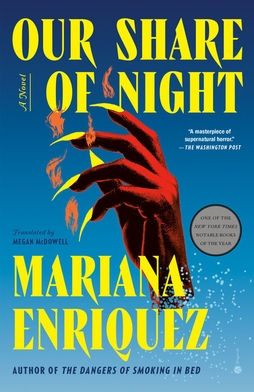
There is so much going on in Our Share of Night, Mariana Enriquez’s ambitious, at times chaotic and bewildering, but always highly entertaining fusion of supernatural horror and recent history, that it’s easy to lose sight of the deeper socio-political truths that inform the Byzantine narrative. Although not without its flaws—the story takes a while to get going, and at times seems in danger of losing momentum; some important characters are never fully realised; descriptive passages sometimes stall in their tentativeness and indecision; and certain ideas and metaphors become wearisome as a consequence of repetition—at precisely those moments when you think it’s about to collapse in on itself, Enriquez conjures up a particularly startling image (startling because of the juxtaposition of banal horror and political reality) that shifts the narrative on to another, more disturbing and esoteric plane. Shortly after arriving at the country estate of his in-laws, for example, after an interminable car journey mapped out over the best part of 100 pages, we learn through Juan—one of the three principal characters—of a tunnel beneath the house where Mercedes, his mother-in-law “used to lock up children and prisoners,” the “poor forgotten people, so abandoned they didn’t even turn to the authorities if a son or brother went missing,” precisely because many of them are “detainees her military friends handed over to her.” This connection between the Disappeared—the victims of the military junta of Argentina’s Dirty War of the 1970s—and those sacrificed by Mercedes as a necessary part of her belief in the “exercise of cruelty and perversion as the path to secret illumination,” is central to the novel’s preoccupation with the legacy of colonialism and class exploitation.
In spite of its slippery nature, and the abrupt shifts in time and character perspective, the story is easily enough summarised. The central narrative unfurls in the book’s three longest sections, the first of which takes place in summer 1981 with Juan Peterson driving from Buenos Aires to Puerto Reyes, a country estate in northeast Argentina, with his six year old son Gaspar. Juan will play a key role in the Ceremonial, an occult ritual at which the members of a powerful cult known as the Order, use a medium—Juan—to summon a mysterious entity called the Darkness, from which, through means of human sacrifice, they hope to discover the secret of immortality through mind transference. The recent, accidental death of his wife, Rosario, has injected a note of urgency into Juan’s quest to protect his son and prepare him to resist the malign interest of the Order’s elite, who have have plans to nurture him as a new and more powerful medium. Juan wants to spare the boy the merciless brutality and horror of the ceremonial—a ritual that mirrors the atrocities committed by the military junta—but although his ability as a medium makes him a powerful figure, he’s also weakened by degenerative heart disease, as well as the cumulative burden of his role as the conduit between the Order and the Darkness. En route to Puerto Reyes, Juan spends time with Tali, his sister-in-law, and with Stephen, the son of Florence Mathers, the current leader of the order. As well as being his lovers, Stephen and Tali are also key allies in his struggle against the cult.
The section culminates in Juan’s participation in the Ceremonial, where we see precisely the physical and psychic toll inflicted upon him. In the ritual his hands are transformed into “bird claws, completely black, burnt, but sticky-looking”; the Darkness grows around him “as if it were steam coming off his body” and proceeds to devour eight sacrificial victims. In the aftermath, he is left exhausted, feverish and unconscious for 24 hours. Upon recovering, Juan warns Mercedes and the cult’s leader, Florence, that he has enacted some magic of his own to protect Gaspar, and an uneasy truce is agreed between them, with the Order’s elders saying they will not seek out the child until he comes of age. It’s a disturbing and hallucinatory sequence, in which Enriquez treads a fine line between pulp hyperbole and more self-conscious literary flourishes, and by the end we’re left bewildered, struggling to make sense of what we’ve witnessed, of the precise nature of the connection between the story’s sinuous and elusive threads.
After a brief interlude in which we’re told how Juan’s heart surgeon, Dr Jorge Bradford—himself a powerful figure in the order—first discovers Juan’s ability as a medium, and of Bradford’s own encounters with the Darkness, the narrative jumps forward a few years, and the focus moves on to Gaspar. Back in Buenos Aires, the ten year old boy’s relationship with his father has become increasingly fraught—even at times shockingly abusive—as Juan, his health deteriorating, tries to prepare his son for life without him. Gaspar finds some solace in the company of his friends Adela, Vicky and Pablo but their days are marked by odd and sometimes distressing events. Although these events in themselves seem minor— Vicky’s dog disappears, on TV the kids witness the final days of Omaira Sanchez, a 13 year old girl trapped in mud and water as a result of a landslide caused by a volcanic eruption (a scene that signals contemporary obsessions with human tragedy played out as spectacle for the 24 hour news cycle), and the weird buzzing sound that seems to follow Vicky around—taken together, and alongside their fascination with an old, abandoned neighbourhood house with bricked up windows, and the peculiar and disturbing stories they hear about its former occupants, these events portend a disturbing and tragic encounter when the kids finally pluck up the courage to enter the building.
Two further sections interrupt the main story, and though these digressions initially seem frustrating, like the Dr Bradford interlude, they shed new light on what has already been revealed, adding detail and texture to the political and historical threads woven through Enriquez’s carefully structured narrative, as well as deepening our understanding of the motives and intentions of the central characters. The longest and most substantial of these interludes is the second, ‘Chalk Circles’, told from the point of view of Rosario, Juan’s wife, in which some of the gaps in our knowledge of the entwined histories of the Order’s two pre-eminent families, the Mathers and the Bradfords, are sketched in. Rosario, a numinous presence throughout the first section, is, here allowed to speak for herself. Enriquez makes clear that despite being deeply invested in the culture and practices of the Order, it is Rosario’s love and empathy for Juan, and her recognition of his fate and the fate of their (at this point, unborn) son, that motivates Juan’s attempts to prevent Gaspar from becoming the Order’s tool. It is she who encourages the relationship between her sister and Juan, and Juan and Stephen, knowing how crucial such allegiances will be, particularly against a woman—Florence Mathers—whose craving for arcane knowledge and power, led to her attempting to school her younger son, Eddie in becoming a medium, with horrific and devastating consequences.
The third interlude is narrated by Olga Gallardo, a journalist compiling a report into the discovery of a mass grave, whose investigations lead her to discover connections between the fates of the Disappeared and the practices of individuals involved with the order. Like Rosario, Olga’s detective work adds to our background knowledge of the events that coloured Gaspar’s later childhood, at least until, while pursuing the truth about the fate of one of his friends, she finds herself prevented by some mysterious force from locating Gaspar’s house. An unsettling encounter with a representative of the Order prompts her to abandon the investigation and doubt it will ever see the light of day.
The final section shifts the focus back on to Gaspar, covering a ten year span in which the boy becomes a man, albeit one still struggling to understand his arcane and bloody inheritance, while at the same time trying to the resist the compelling lure of the Order’s malevolent influence. Reflecting on a warning he had received from a former lover, to give up his dead, Gaspar acknowledges his ambivalence: “They sought me out, here I am. I don’t know how to let go of the dead.”
The novel would undoubtedly have benefited from some deft editorial pruning, particularly of aimless descriptive passages where nothing is said at length, and that serve only to induce the kind of torpor analogous to that which both Juan and Gaspar feel after encounters with the Dark. Certain ideas and phrases are repeated without any real development, and some of the novel’s events take an age to play out. And yet, although it won’t satisfy—and may even repel—many of its readers, for all its meanderings and missteps, Our Share of Night is a hugely ambitious, inventive and compelling work of modern fantasy. It wears its influences lightly: particular sequences, themes and images, offer riffs on specific works by Stephen King, Alan Moore and Mark Danielewski; gothic and magical realist tropes are picked up, played with and tossed aside; ancient rituals, human sacrifice and the tarot are repeated motifs; another is the Left Hand of Darkness, which not only links anthropologist Rosario to the protagonist of Ursula Le Guin SF novel of the same name, but also draws parallels between Juan’s pansexuality and the ambisexual inhabitants of Gethen. Music, and specifically the rock music of the counter-culture of the late 1960s, plays an important role, with allusions to the Rolling Stones, the Velvet Underground, Hendrix, and, significantly, David Bowie, who is mentioned as a lover of one of Rosario’s inner circle of friends while they are residing in London. These allusions are not there merely to add period colour, they serve to suggest potent links between the liberating power and influence of contemporary music and culture on the rarefied existence of these fugitives from the Argentine elite, and also, with the Stones and Bowie’s flirtations with the occult, to imply that the fascination went both ways.
In the end though, what lends the book its unsettling power, is the extent to which Enriquez succeeds in blending these disparate, and at times antithetical, elements, to craft a work that exposes the bitter truth of how the poor and dispossessed were, and continue to be, exploited by the rich and powerful. The point is made clear to Rosario: when she questions her father about the need for human sacrifice, he responds, “These people are marked for death, girl. We’re doing them a favour.” Such explicitly stated contempt for ordinary people continues to resonate.
© Mike O'Driscoll, April 2023